

_edited.png)
Why is WASH the Missing Link in Sustainable Tourism?!!

"Water security, sanitation infrastructure, drainage systems, and waste management are not simply environmental services; they are critical tourism assets."
Across the world, tourism destinations are investing heavily in new attractions, improved connectivity, visitor facilities, and destination marketing. Governments are promoting tourism as a driver of economic growth, private investors are developing hotels and resorts, and communities are increasingly participating in tourism-related enterprises. Yet, amid this rapid expansion, one critical component often remains overlooked—not because it is unimportant, but because it is largely invisible until problems emerge. That component is WASH: Water, Sanitation, and Hygiene.
When most people think about WASH, they think of drinking water, toilets, and cleanliness. However, in reality, WASH forms the foundation upon which every successful tourism destination operates. Every hotel room, restaurant, homestay, campsite, attraction, public facility, and tourism experience depends on access to water, effective sanitation systems, drainage infrastructure, wastewater treatment, and waste management services. Without these systems functioning efficiently, even the most attractive destinations can struggle to sustain tourism growth over time.
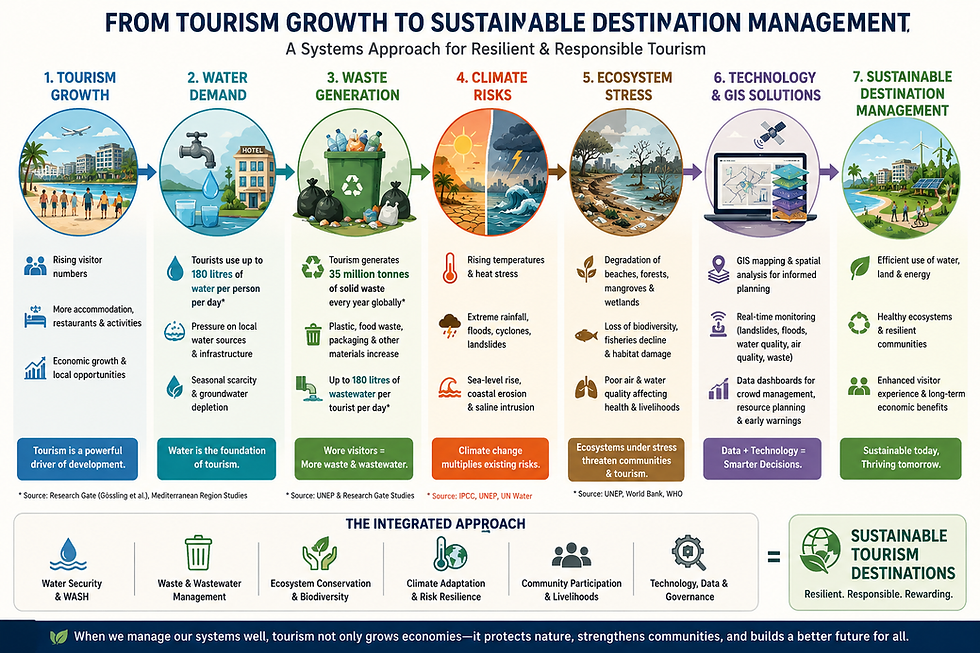
The relationship between tourism and WASH is far more interconnected than it initially appears. Tourism places increasing pressure on water resources, sanitation systems, and waste management infrastructure, while the quality of these systems directly influences visitor experience, public health, environmental quality, and destination competitiveness. In many destinations, tourism and WASH exist in a continuous cycle where each influences the success or failure of the other.
As visitor numbers grow, so does water demand. Hotels, restaurants, recreational facilities, public amenities, and tourism businesses all consume significant quantities of water. Research suggests that tourists can generate up to 180 litres of wastewater per person per day, while tourism activities globally contribute an estimated 35 million tonnes of solid waste annually. In destinations where infrastructure has not kept pace with growth, this increasing demand often places considerable pressure on local resources and services.
The consequences are visible across geographies. Beaches struggle with plastic pollution and wastewater discharge. Mountain destinations experience water shortages, waste accumulation, and increasing vulnerability to landslides. Forest and wildlife destinations face growing pressure on fragile ecosystems and limited infrastructure. Arid regions encounter intensified water stress and groundwater depletion. While the landscapes may
differ, the underlying challenge remains remarkably similar: tourism growth is often planned, but resource management is not.
What is often overlooked is that the impacts extend far beyond tourism itself. Water scarcity, poor wastewater management, and inadequate drainage systems affect agriculture, fisheries, biodiversity, and community livelihoods. Farmers and tourism businesses frequently depend on the same water sources. Groundwater depletion caused by increasing demand can affect irrigation, crop productivity, and agricultural resilience. Waterlogging resulting from inadequate drainage can damage farmlands, alter cultivation cycles, and increase public health risks. Untreated wastewater can affect soil quality, contaminate water sources, and reduce the long-term productivity of agricultural landscapes.
This relationship becomes even more important when we consider the growing role of agritourism and food-based tourism experiences. Across many destinations, local farms, orchards, vineyards, traditional agricultural practices, and regional cuisines form an integral part of the tourism offering. The food served in hotels and restaurants, the experiences offered through farm stays, and the cultural landscapes that attract visitors all depend on healthy agricultural systems. When agriculture becomes economically unsustainable due to water stress, pollution, or changing land-use patterns, tourism ultimately loses one of its most valuable assets.
A similar story can be seen in coastal and riverine communities where fisheries play a vital role in local economies. Wastewater discharge, plastic pollution, and the degradation of wetlands and mangrove ecosystems directly impact fish breeding grounds and aquatic biodiversity. As fish stocks decline and fishing becomes less viable, local livelihoods are affected. Over time, this can alter the social and economic fabric of destinations that rely on both tourism and traditional occupations.
When WASH Becomes a Tourism Issue
While tourism undoubtedly places pressure on water resources, sanitation systems, and waste management infrastructure, the relationship does not operate in a single direction. The quality of WASH systems within a destination ultimately influences the quality of the tourism experience itself.
Today's travellers are increasingly conscious of environmental quality, public hygiene, and sustainability. Clean beaches, safe drinking water, well-maintained public facilities, effective waste management systems, and healthy natural ecosystems are no longer considered additional amenities; they are fundamental expectations.
A destination struggling with water shortages, polluted water bodies, unmanaged wastewater, littered public spaces, or inadequate sanitation infrastructure is likely to experience a decline in visitor satisfaction, regardless of the quality of its attractions.
The implications extend beyond visitor comfort. Poor WASH conditions can directly affect public health, environmental quality, and the overall perception of a destination. In an era where travel decisions are heavily influenced by digital platforms, social media, and online reviews, a single image of a polluted beach, an overflowing waste collection point, contaminated water, or poorly maintained public facilities can influence thousands of potential visitors. As competition among destinations continues to increase, environmental quality and cleanliness are becoming key determinants of destination competitiveness.
Furthermore, poor WASH management can increase operational costs for tourism businesses, reduce the quality of local resources upon which tourism depends, and weaken the resilience of destinations to future growth. In many ways, water security, sanitation infrastructure, drainage systems, and waste management are not simply environmental services; they are critical tourism assets that support visitor experience, destination reputation, and long-term economic sustainability.
Put simply, tourism influences WASH systems, but the strength of WASH systems ultimately determines how successfully tourism can grow and sustain itself over time.
Climate Change: Amplifying Existing Vulnerabilities
Climate change is adding another layer of complexity to these interconnected challenges. Destinations around the world are experiencing more intense rainfall events, prolonged droughts, heat stress, flooding, coastal erosion, cyclones, landslides, and changing ecosystem behaviour. These impacts place additional pressure on already strained WASH systems while simultaneously affecting agriculture, fisheries, biodiversity, infrastructure, and tourism operations. What were once occasional disruptions are increasingly becoming recurring realities.
As climate risks increase, destinations need stronger and more resilient WASH systems than ever before. A drainage system that was sufficient ten years ago may no longer be adequate today. Water sources that once supported communities throughout the year may now face seasonal stress. Waste management systems may struggle to cope with increasing visitor numbers and climate-related disruptions.
The challenge is no longer simply about providing infrastructure. It is about building resilience.
Why Technology Must Become Part of the Solution
For decades, destination planning has largely relied on historical trends, fragmented datasets, periodic surveys, and reactive interventions. Problems such as flooding, water scarcity, waste accumulation, overcrowding, ecosystem degradation, or infrastructure failures are often addressed only after they begin affecting communities, visitors, and local economies. However, as tourism destinations face increasing pressures from climate change, resource scarcity, and growing visitor numbers, this approach is becoming increasingly unsustainable.
Destinations today require a deeper understanding of how natural systems, infrastructure networks, visitor behaviour, and environmental resources interact with one another. This is where technology can play a transformative role. By leveraging GIS mapping, spatial analysis, digital monitoring systems, predictive analytics, and real-time data platforms, destinations can move beyond reactive management and towards proactive, evidence-based planning that helps identify vulnerabilities, optimise resources, and build long-term resilience.
GIS mapping and spatial analysis can help identify:
Flood-prone zones
Waterlogging hotspots
Groundwater recharge areas
Natural drainage channels
Land-use changes
Sensitive ecosystems
Infrastructure gaps
Digital monitoring systems can track:
Waste generation patterns
Water consumption trends
Visitor movement
Crowd density
Carrying capacity thresholds
Climate monitoring tools can support:
Heat stress mapping
Landslide monitoring
Flood forecasting
Water quality assessment
Early warning systems
Rather than reacting to crises after they occur, destinations can identify vulnerabilities, forecast risks, allocate resources efficiently, and make informed planning decisions.

The Future of Tourism Depends on WASH
The future of tourism will not be determined solely by visitor numbers or hotel occupancy rates. Tourism planning can no longer be limited to attractions, hotels, roads, and marketing campaigns.
Increasingly, it will be determined by how effectively destinations manage water resources, sanitation systems, waste streams, ecosystems, agricultural landscapes, climate risks, and community well-being. Sustainable tourism is no longer simply about attracting visitors; it is about ensuring that the natural, social, and economic systems that support tourism remain healthy and resilient for generations to come. This is precisely why the future of destination management must become more integrated, data-driven, and resilient.
Perhaps it is time we stop viewing WASH as a supporting service and start recognising it as one of the most important pillars of sustainable destination management.

Comments